- Sign In Changes: You now need to sign in using the email address associated with your account, combined with your current password. Using your display name and password is no longer supported.
- If you are currently trying to register, are not receiving the validation email, and are using an Outlook, Hotmail or Yahoo domain email address, please change your email address to something other than those (or temporary email providers). These domains are known to have problems delivering emails from the community.
Leaderboard


Popular Content
Showing content with the highest reputation on 03/17/2019 in Posts
-
Everyone has pretty much nailed it. For a lift within the 2-2.5 inch range there really isn’t much concern. Upgrade all of the usual wear and tear items on the front end like ball joints, bushings, and sway bar links at the same time as putting in the lift and you should be in good shape to not deal with any failures for quite some time. And definitely budget for manual hubs. Being able to fully disengage the hubs when you don’t need 4wd makes the CV angles almost a non issue at least for regular street driving. I personally couldn’t be happier that I lifted my R50!4 points
-
I've had the AC heavy duty 2 inch spring lift for the past 10 years. At the same time I changed the shocks and struts and put in manual hubs. I've had larger tires the whole time, right now 265/70R16s. I've had zero extra problems related to it. It rides really rough, but the handling is much better than stock. Just in the last 6 months I have a minor clunking in the front suspension when turning hard over a bump at slow speed. But at 260k miles and as hard as I drive it in the city, I think it is due to be a little tired. At this point with the youngest R50 being 15 years old, the last thing I would be worried about is resale value. I'd be more worried about spending a bunch of money on it and it not lasting long. Sent from my SM-N950U using Tapatalk4 points
-
And beyond personal testimonies, if you start reading through this forum a lot, you’ll have a tough time finding people complaining about their lifts.And besides, if your like most people who want a lifted 4x4, the small nuances won’t matter in conparison to how much you enjoy being lifted.4 points
-
The setup you mentioned being set on is the exact setup I have(OME/AC heavy duty springs up front, LR 9449 rear springs) with 275/55 20's(32"). To date I have not had any issues. As the other posters have mentioned, it drives a little different and the ride is more stiff. But I'll say I have been very impressed with the road ride quality. When I go off road is when I feel the rigidness in the suspension. I changed out my CV axles, but only beacause of the post concerns when doing my initial research about lifting it. They didn't really need to be changed. I also put manual hubs on which has been a big benefit as well. The setup you are thinking of going with should be just fine. Yes some things will be out of their normal range which could cause more potential strain on them. If you go in knowing this and are o.k. with changing a FE suspension part every now and then, just lift it! Sent from my SAMSUNG-SM-G930A using Tapatalk4 points
-
Thanks everyone for the continued support and patience! I know this thread has tangented off a few directions so far, and that was ok since I think it spawned a little excitement in everyone (including ourselves) to get more products out there. Going forward, though, we'd love it if the discussion stay centered on some of the ideas we're working on and any related questions. We're aware that competing products do, or may soon, exist. But, that doesn't phase us, impress us, nor change our goals here. What we've been working on is far more dynamic than anything out there. We're due for another update, no doubt. We've got a big one coming very very soon (hint: tonight?). Let's just say that yesterday was a major R&D and prototype day for us. Stay tuned!3 points
-
This topic went way off topic. But, @Astrorami is just pulling legs here. I'll leave my opinion about what I think of that Russian kit out of this discussion (it'll come up elsewhere I'm sure). @MTGunner, I don't have any experience with Nexen tires or those Rodians, but as a general perspective, we're quickly becoming a consumer base where once-thought "off-brand" tires are becoming "new-brand" tires that are probably worth a shot. Consider that automakers have already begun making them OE, and that top retailers like Walmart and Tire Rack are willing to buy enough of them to push the brand. I generally take that acceptance (and any underlying quality-assurance and certification processes) as a good sign that tire is of reasonable quality. Tires are what I consider another totally subjective purchase item. People love Duratracs, though I tend to hate them because I had a set that failed in ways that I don't think it should have. Does it seem like a good tire? Yes, and I liked them up until they failed on me. Should that stop you from buying them? No, not all. But, I honestly feel anyone could have had the same experience with any set of tires. That all said, if it reads like a good deal, meets your needs, carries a good warranty, and the majority of reviews are good, I'd totally give them a try.3 points
-
Honestly the missing link does very little. It’s one of those things that is so cheap and easy that there’s just no reason not to do it, but it’s not a game changer. If anything it does tighten up the handling a little bit. I 100% think all R50’s should have it because it’s that easy, I just don’t want anyone to get false expectations on what it will do.3 points
-
Here's my 2 cents. Find a new mechanic or ditch 'em altogether. Lifting your rig is not going to devalue it at all, and any true car guy doesn't give a darn about value anyway, it's about what the car means to you. Lifting it is not gonna just make all your parts stop working all of a sudden or lead them to break more often than just driving the car is. As long as you do everything right you will have no problems. Increasing control arm angle theoretically wears it out faster but I've never had any problems with mine. As long as the angle is still within operating limits (in other words, as long as you don't use spacers) your cv's will still be within the limit they were designed to work at. I've said the same thing in another thread somewhere but basically you can put however much lift you want in the front as long as the spring still fits in the original strut. The cv axles were designed to work within the full range of suspension travel all the way up to full extension, so even if you could theoretically fit a spring in that held the strut all the way topped out all the time the axles would still work in 4wd fine. Of course you'd have other problems then but that's purely for example. You don't experience any problems until you add a spacer into the mix. Since a spacer goes on top of the strut it allows the suspension to drop to full extension PLUS however much the spacer adds, which allows the control arm and axles and whatnot to drop past the range in which they were meant to operate within. For example, if you have a 2" spacer on top of your strut, at full droop your wheel will be able to extend the full length of the topped out strut plus another 2 inches past, which is 2 inches lower than the axles were made to operate at. For the rear you can basically do whatever you want until you reach around 6" which is where you start running into driveshaft issues. Lifting your car isn't really gonna affect it negatively at all, it'll only benefit. You'll have more suspension travel, better handling and a better ride, better articulation, and have a way cooler car in general that can get places it couldn't before. When it comes down to it, lifting your car is making it way better, not worse.3 points
-
I could make a really long post, but I'll say this simply; CV's, ball joints, and tie rods will be at a steeper angle than stock. Other than those parts, everything else shouldn't be affected in any really significant way. Sure things will wear quicker overall, but the off-road use you'll put it through when lifted will probably be more of a factor on most components than the lift itself. In my opinion biggest struggle you'll run into will be alignment, as far as parts wearing out I wouldn't worry about it. Your mechanic is right to be concerned, but he's definitely making you freak out more than necessary. Unless you're wheeling really hard you'll probably only have to replace anything once since it's really old anyways, and after that the parts will last quite a while as long as you get quality parts.3 points
-
[emoji22]You people with your clean garages sicken me! [emoji1785]2 points
-
Its going down! I took the tape to it and gave myself some options of least to most drastic, and slept it. I went least aggressive and I'll see how I think about crazier angles later. Here's the photo dump of the first side completed I'll post more when the other side is complete2 points
-
The sfd kit looks very well thought out and really high quality. I will be proud to have one on my rig this year. Here’s a little picture from yesterday’s work day@Towndawgr50 ‘s test center. Sent from my iPhone using Tapatalk2 points
-
It’s been said before, and ya, the results vary, most people either get a placebo effect or notice a small difference. Though it’s worth noting that @Jax99 wheeled an SFD equipped rig that had no missing link, and his subframe actually cracked and tore. Pictures and explanation of it in his build thread.2 points
-
I ran a 2.5” lift for a while, no issues except for CV wear on the trails due to binding. Then I did a 4” SFD, still no problems really. It’s when I threw on bigger tires that I started seeing a bit more wear and a difference in performance. After that, I went on to build my 7” SFD and lift, which of course has been a pain on its own, but it’s been holding sturdy and still stays nice and smooth on the highways as a daily. Is it a luxurious ride when lifted? Absolutely not. Lifting the Pathfinder pretty much removes all comfort in the suspension, makes it a little less stable to drive, but if you get used to it, you’re fine. That aside, I’ve done a lot of rework to my suspension and such over time due to general wear and tear, at almost 200,000 miles, so it’s hard for me to gauge properly. I would say, however, to expect to go through CV axles and U-Joints more frequently, ESPECIALLY if you don’t get manual locking hubs. They’re your saving grace when it comes to lifting these, and promoting drivetrain longevity in general. I know I’m bouncing around a bit, but to summarize, your mechanic is right. A lift will devalue the vehicle, unless someone really wants a lifted pathfinder. Lifts are usually accompanied by bigger tires, which puts additional stress on the transmission, engine, driveline, and so on. Really, anything you do to modify the suspension and such will cause additional wear, because you’re making it do things it was not “designed” to do. The R50 is built well though. I’ve put mine through hell and back and I know what to expect. If you know you’ll need to do a bit more maintenance, and understand the risks of things breaking more frequently or when unexpected, you’re set. If you aren’t ready for that expense, there ARE easier/less expensive vehicles to lift and maintain. These are, of course, opinions from my experience.2 points
-
Yes, in static and adjustable options.1 point
-
Are those beefy trailing arms gonna be on the list of products?1 point
-
Just hollow em out and get some non foulers! Lol1 point
-
Completely agree. I have >100K and most CO Passes under my belt with stock & Airlift 100s in the back. TONs of SW desert miles. I would consider the airlifts for a cheap & easy rear end sag fix, otherwise a spring - spacers really give you nothing but aesthetics. For easy drivability you probably would want to stick with OME/LR. I think the most perfect simple build I’ve seen is @02_Pathy (I don’t know why that reference never sticks). As he drove away last night, both[mention=37543]TowndawgR50[/mention] & I spontaneously said to each other what a great looking truck it is. Straightforward, clean, practical build (& pretty too). Look for the IG photos because he’s taking it to UT soon.1 point
-
I mentioned this in another thread but figured I’d share a teaser of what I’m working on next. It’s either going to be awesome, or an epic fail...lol! With the addition of the tube bumper, and plans for a winch in the near future, I need to finally upgrade from the stock springs up front. I considered ordering the OME HD’s, but I like to be different and decided to experiment a bit. I’ve been doing a lot of research on sites that supply parts for race car builders and have a lot of components for building custom suspension set ups. I settled on these springs And the plan is to pare them with this adjustable spacer on the bottom strut perch. Since the stock springs are wider at the bottom than the top, and the aftermarket springs aren’t, I went with springs that should fit the top strut mount and the adapter should take care of the problem of being a bit too small for the bottom mount. I’m going to keep the 2 inch strut spacers I already have, so my plan is to use this combo more for increased load capacity and not necessarily set it up for much more lift. But, if my calculations are correct, than this spring and adjustable spacer combo should able to provide up to 2.5-3 inches of lift without spacers. I’ll update this when I get time to actually dig into it. Sent from my iPhone using Tapatalk1 point
-
Hard to beat those Land Rover springs. They end up bein about 70 shipped. Barely even more than off brand stock stuff1 point
-
It basically connects the back ends of where the control arms mount so they can't pull apart from each other, it doesn't prevent or effect suspension travel.1 point
-
That would make sense. Thanks Sent from my iPhone using Tapatalk1 point
-
just something to add! the “missing link” also helps those cvs with the spacers. i feel like as it stiffens the front it adds little more resistance to over flexing the front since you’re connecting independent suspensions?? feel free to tell me i’m wrong here though Sent from my iPhone using Tapatalk1 point
-
another vid i put together i want to share it with you guys1 point
-
January 2017 Prairie SVRA1 point
-
January 2017 Prairie SVRA1 point
-
To add just a little to Micah’s response regarding spacer lifts, he’s right that it puts the CV at greater risk of damage. With my 2 inch spacers (which yield approx 2.5 inches of lift), they definitely start to bind up at full strut extension. Meaning if it is lifted all the way to the point of the wheel hanging off the ground. This really isn’t a problem at all on the street, and if you’re mindful off road and take it slow it isn’t that big of a deal, but it is definitely a legitimate concern that does not come into play with spring only lifts.1 point
-
I just posted this in a different thread but I'll paste it here too since it applies: Here's my 2 cents. Lifting your rig is not going to devalue it at all, and any true car guy doesn't give a darn about value anyway, it's about what the car means to you. Lifting it is not gonna just make all your parts stop working all of a sudden or lead them to break more often than just driving the car is. As long as you do everything right you will have no problems. Increasing control arm angle theoretically wears it out faster but I've never had any problems with mine. As long as the angle is still within operating limits (in other words, as long as you don't use spacers) your cv's will still be within the limit they were designed to work at. I've said the same thing in another thread somewhere but basically you can put however much lift you want in the front as long as the spring still fits in the original strut. The cv axles were designed to work within the full range of suspension travel all the way up to full extension, so even if you could theoretically fit a spring in that held the strut all the way topped out all the time the axles would still work in 4wd fine. Of course you'd have other problems then but that's purely for example. You don't experience any problems until you add a spacer into the mix. Since a spacer goes on top of the strut it allows the suspension to drop to full extension PLUS however much the spacer adds, which allows the control arm and axles and whatnot to drop past the range in which they were meant to operate within. For example, if you have a 2" spacer on top of your strut, at full droop your wheel will be able to extend the full length of the topped out strut plus another 2 inches past, which is 2 inches lower than the axles were made to operate at. For the rear you can basically do whatever you want until you reach around 6" which is where you start running into driveshaft issues. Lifting your car isn't really gonna affect it negatively at all, it'll only benefit. You'll have more suspension travel, better handling and a better ride, better articulation, and have a way cooler car in general that can get places it couldn't before. When it comes down to it, lifting your car is making it way better, not worse.1 point
-
I don’t want to know my resale value lol. I’m driving this thing till the wheels fall off. But I completely agree with you the last thing I want is to pour all this money in with the lift and tires and then watch the truck fall apart. Thank you for the reassurance! Sent from my iPhone using Tapatalk1 point
-
Mind. Blown.1 point
-
Here's and idea! Sell the Scion and use the money to put one of those 2.5l Cummins motors in the Pathfinder! Then you'll get like 30mpg and it'll be cheaper than paying off that scion haha1 point
-
A 2” lift is perfect for that sort of thing! It likely would have, and I’ve seen plenty of people who have done so with little issues aside from misalignment of the suspension and so on. I would say 2” is still within the comfort zone before you really start causing additional wear. Just understand, at 2” and beyond, without a SFD, you do operate your CV axles at more dramatic operating angles, which increases wear. I cannot stress enough how great of a solution manual locking hubs are for that issue. On the trails, though, you’ll wanna take it nice and slow when going into deep areas where the front suspension might droop to its max extension, because at that point you’ll be within the binding range of the CVs. And you’ll know, too, when it isn’t spinning anymore. If you take it nice and slow, you’ll just notice you can’t get traction or move, and should back off and retry with a different approach. If you go flooring it or cruising through a drop, you’ll likely snap your CV joint, but I haven’t had any experience doing so, as I’m rather careful to reduce any additional cost on every trail!1 point
-
Ok thank you both. Small things wearing out are just fun to fix every once in a while . As long as nobody else ran into any major problems, I don’t think lifting will be a bad decision. Thank you for the reassurance. Sent from my iPhone using Tapatalk1 point
-
Picked up this Scion coupe for a good price and will help when commuting from college, work, and home. The pathfinder was too bad in gas mileage to justify keeping it especially with the amount of time I spend driving. Looking to sell it, but toying with the idea of keeping it in the family. Loved this car as it was my first and glad I found this forum along with everybody that helped! Will update in whether I’m keeping it or not but still undecided. I plan to stay on this forum and communicate with everybody!1 point
-
Ugh.... Getting ready for complete engine rebuild. Sent from my iPhone using Tapatalk1 point
-
There are different spring rates and lengths available, but it’s not quite that easy because the stock front springs on the R50 are tapered. They are a larger diameter at the bottom than at the top, which really limits the use of universal springs because most universal springs are equal diameter top to bottom. That’s how I decided I could get a spring that would fit the upper mount, and use an adapter at the bottom to open up my spring options. Since I already knew I needed an adapter, I figured it made sense to make it adjustable at the same time.1 point
-
I’m actually in the middle of an experiment right now for my front springs. I’ve been scouring websites that supply custom parts for race cars because they have a ton of options for people who are building their own suspension components. I settled on a spring with a 250 lb rate and a free height of 13 inches. 250 puts it in between the OME and AC coils which is what I’m looking for. I chose the 13 inch spring height ( 3 inches shorter than the OME hd) because I’m pairing them with an adjustable height spring spacer (similar to the way a coil over sleeve works) that I plan to adapt to the lower spring perch on the strut. If it all comes together as planned the adjustable lower perch will let me dial in my front ride height exactly where I want it. Total cost so far is $145 for the springs and spacers. Hopefully I’ll get time to work on it next weekend and I’ll update with results then.1 point
-
Suspension update: After having the LR 9449's on with my old shocks I found out that they were too short now. So I went ahead and bought some Bilstein 33-185569 5125's and man what a difference. I got so much more travel now and can actually flex and tuck a wheel now. Before the shock would pick up my wheel but now the wheel stays in contact with the ground. Sent from my SM-G960U using Tapatalk1 point
-
Thank you so much! That is awesome. That’s a ton of rear flex. And you recommend that part number over the one I found? I don’t understand what the difference in valving means in practical terms1 point
-
Couldn't have said it better1 point
-
Thanks. I don’t want to thread jack this, but I’ll say I checked out the Facebook page a little and came the conclusion it really wasn’t for me...no offense at all to anyone who likes and uses it. Regarding SFD, I feel confident that anything Towndawg and Hawairish put out would be safe and well engineered so I’ll probably hold off for that for now.1 point
-
Something I've found myself reminding others about is that OME springs and shocks are intended for increased load handling, not lift. I don't consider them lift springs at all; it's not what they're meant for (that's not to say they don't provide lift). For R50s, all their springs have an estimated lift of 15mm when used according to their loading specs, which are standardized for all their springs: Light duty: no accessories Medium duty: bumper or winch, up to 50kg or 110lbs Heavy duty: bumper and winch, up to 100kg, or 220lbs I get about an 1.25" of lift from them because my winch and bumper setup is towards the low/mid range of the HD application, maybe around 140 lbs. Still, I rely on my strut spacers for lift, and the springs for handling, and they don't disappoint.1 point
-
It’s a whole herd! Sent from my iPhone using Tapatalk1 point
-
Sent from my iPhone using Tapatalk1 point
-
Sent from my iPhone using Tapatalk1 point
-
Got my full size spare tire mounted Sent from my SM-G960U using Tapatalk1 point
-
That looks great with that bumper & those lights!1 point
-
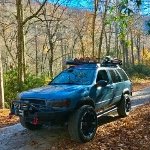
Went joy riding to find a few waterfalls with the kids on this gloomy North GA day! Sent from my SAMSUNG-SM-G930A using Tapatalk1 point
-
Pathfinder Pest Control. Tried a new way to kill off the moles who are destroying my yard....we’ll see if it works?1 point
-
Like Hawairish mentioned earlier, Ive started working with him on the design of these brackets. He sent me the data to punch out a set, using his current iteration, so I can start mock up on my rig and work with him on the R&D end. I have a chunk of time coming up and plan to push on this project so I can finally get rid of the XJ bumper and help however I can to get these on the market!1 point