- Sign In Changes: You now need to sign in using the email address associated with your account, combined with your current password. Using your display name and password is no longer supported.
- If you are currently trying to register, are not receiving the validation email, and are using an Outlook, Hotmail or Yahoo domain email address, please change your email address to something other than those (or temporary email providers). These domains are known to have problems delivering emails from the community.

XPLORx4
-
Posts
2,583 -
Joined
-
Last visited
-
Days Won
47
Content Type
Profiles
Forums
Calendar
Everything posted by XPLORx4
-
What did you disassemble to clean the TB?
-
A P0507 DTC trouble code may be caused by one or more of the following: A vacuum leak Leaking air intake after the throttle body EGR valve leaking vacuum A faulty positive crankcase ventilation (PCV) valve Damaged/failed/dirty throttle body Failed EVAP system Failed IAC (idle air controller) or faulty IAC circuit Read more at: https://www.obd-codes.com/p0507 Copyright OBD-Codes.com
-
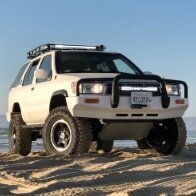 If it weren't for the fact that the Rancho 9000XL shocks don't fit on my '97, I would have used them instead of the Bilsteins, simply because of the adjustability. That being said, the Bilstein 5150's I have now are pretty good. I have an '05 Sequoia, on which I installed Rancho 9000XL's, where they are working quite well.
 -
Yeah I was going to suggest that the issue may be one (or more) of: IACV (idle air control valve) MAF sensor vacuum leak
-
If you're planning to get Rancho shocks for the rear, get 999010. The 999112 are not valved firmly enough for the R50. (No Rancho 9000XL shocks are recommended for 96-99 R50 models due to the fact that the wider shock body can be dented by the panhard rod bracket when stuffing the left wheel and dropping the right. The modified shock mounts on 99.5-04 models do not have this issue.) Here are some previous posts discussing various rear shocks: http://www.nissanpathfinders.net/forum/topic/41653-help-with-rear-shocks-for-lift/?hl=bilstein&do=findComment&comment=774105 http://www.nissanpathfinders.net/forum/topic/40487-ac-2-lift-shock-options/?hl=bilstein http://www.nissanpathfinders.net/forum/topic/32456-suggestions-for-new-rear-shocks-looking-at-rancho-rs9000xl/?hl=5165&do=findComment&comment=612059 http://www.nissanpathfinders.net/forum/topic/33480-2k-qx4-lift/?hl=5165&do=findComment&comment=629210 http://www.nissanpathfinders.net/forum/topic/39966-ac-coilsshocks/?hl=5165&do=findComment&comment=751118
-
SFD- Front Sway Bar Necessary?
XPLORx4 replied to Snowboarder12345's topic in 96-2004 R50 Pathfinders
Unfortunately, any type of quick-disconnect apparatus for the R50 swaybar results in not-so-good results. The swaybar either bangs around on top of the CV axles when disconnected, or if you try to suspend it in a "stowed" position, the ends will hit the tabs on the struts during certain turning maneuvers with the suspension stuffed. If you only disconnect one side, then when that side drops, the swaybar will jam itself against the CV axle. So, removal is really the only option for those of us who want improved front axle articulation. As for damaging the CV axles, the only way you would do that is if you installed strut spacers that allow the lower A-arm to drop further than originally designed when the wheels are off the ground, which may bind the CV joint and cause it to break. If you don't run any spacers that cause binding when the wheels are off the ground, then there's no risk of breaking a CV joint. -
SFD- Front Sway Bar Necessary?
XPLORx4 replied to Snowboarder12345's topic in 96-2004 R50 Pathfinders
I disagree that driving without the swaybar doesn't help with travel. In my experience, it helps tremendously. In tough terrain, the front wheels are free to move up and down independently without forcing the other wheel to move in the same direction. For example, with the swaybar removed, the body will stay more level when you cross up the front and rear axles. With the swaybar attached, there will be a stronger tendency for the front wheels to travel together, increasing body roll and forcing the rear suspension to articulate more. If there is insufficient travel in the rear, it is easier to lift a rear tire and lose traction. In summary, I would not recommend removing the sway-bar from a daily driver, but it is actually preferable to remove it for heavy off-road use where it is important to maximize suspension travel (such as rock-crawling). You just need to retrain yourself to drive differently with the sway-bar removed to/from the trailhead. -
RE: Driving in 1st gear As mentioned by Hawairish above, O/D on/off does not even factor into the transmission shift logic until higher vehicle speeds, so the toggling of O/D on or off is irrelevant. At 5mph, you're not really even locked in gear anyway. There is significant slipping of the torque converter (no risk for damage by overheating) at low engine RPM and speed, no matter what position the transmission selector is in. Pros: instant engine torque available, speed directly proportional to accelerator pedal movement. Less wear on transmission at slow speeds (tranny does not try to shift out of 1st at higher speeds or lower throttle input). Cons: Max speed is RPM-limited to about 35-40. Lower fuel economy. Potentially less comfortable ride for passengers if you don't modulate throttle smoothly. (Vehicle will tend to lurch forward and backward more easily with varying throttle input. While you depress the accelerator pedal, brace the side of your foot against the transmission hump while driving on rough terrain.) RE: Airing down on stock tires You didn't say what kind of tires you have. Again as Hawairish commented, tire size is not as important as tire type when determining how much to air down.The degree to which you air down depends on the tire construction, tire wear, tire tread, weight of your rig, and the terrain you'll drive on. If your tires are highway-tread with weaker sidewalls, airing them down too much on rocks could risk a sidewall puncture. In softer terrain such as sand, you can air them down without fearing sidewall damage. I run all-terrain and mud-terrain load-range-E tires on my rigs, and my preferred PSI for airing down on mixed terrain is 16-18psi. For dry, firm sand, I would go down to about 10-12psi. For highway tires (eg. Dueler HL) I might go 18psi on rocks, 12psi on sand. You'll want to watch how much the sidewalls bulge out at lower pressure. In my opinion, 20psi is actually still pretty high, especially for sand. More info here: http://www.off-road-outdoors.com/tire-pressure.html You can also find a plethora of useful information if you google "airing down tires". RE: christmas wish-list items for your rig (in order of importance) Recovery and emergency gear (ex: tow strap, shackles, receiver hitch, come-along hand-winch*, tree-saver strap, battery cables, paracord rope, leather gloves, first-aid kit) Airing down and airing up equipment: tire pressure gauge, compressor, and automatic tire deflators, such as these: https://www.amazon.com/Staun-SCV5-Tire-Deflators/dp/B00QBPBLWY I have had very good experiences using this MV50 compressor (I have two, one is hard-mounted under the hood of my Pathy (pics here, and the other is still portable.) https://www.amazon.com/Industries-MV50-SuperFlow-12-Volt-Compressor/dp/B000BM8RT8 *I used to keep a come-along in the rear cargo under-carpet storage bin, even after I'd installed an electric winch in my bumper. I used it a couple of times, the most critical being after I lost traction ascending a steep muddy slope, and the rear slid sideways towards a tree as I tried to back down. I had to attach the electric winch to a tree up ahead, then attached the come-along to the rear hitch to pull the back end squarely onto the trail as I then reversed the electric winch to get down the hill.
-
I think the wheel backspacing is too deep. It shouldn't be more than 4.25" (-19 offset) to keep the tire from hitting the strut. You'll need spacers to fit those wheels, but it's preferable to just order wheels with the correct backspacing.
-
SFD- Front Sway Bar Necessary?
XPLORx4 replied to Snowboarder12345's topic in 96-2004 R50 Pathfinders
Running with the front swaybar removed contributes to increased body roll when cornering, so you will need to drive more slowly when cornering. The off-road performance was significantly improved, and the truck felt more stable when crossing into a steep driveway at a 45° angle. I had my front swaybar uninstalled for a few years (2" AC lift), and the truck seemed to wallow a lot more such as when driving on cloverleaf freeway ramps or on twisty roads. On the highway, it never felt unsafe, however. (My rear swaybar broke in 2009 and I never replaced it.) You can certainly try driving without the swaybar, working your way from lower speeds up to higher speeds. You can try carefully performing rapid lane-change maneuvers in a safe location at 20mph and every 5mph after until you feel that the risk of rollover is too great during an emergency lane-change. If at any point you feel the decrease in handling is not worth the improvement elsewhere, just reinstall it. All that being said, I am currently running my front swaybar again because I have been driving my Pathy on the highway much more frequently, and I have not taken it off-road in a while. Depending on the difficulty of the trail I'll run next, I will decide whether to remove it or not ahead of time. -
A tow strap does not have the same elastic properties as a snatch strap.
-
I've used the front tow-hooks as recovery points frequently. As mentioned above, they should be sufficient as long as you're not overzealous like this guy: Also, understand the difference between a tow strap and a snatch strap and how to use them. For the rear recovery point, if you don't have a D-ring hitch, you can insert the tow strap into the receiver and secure it in place with the hitch pin.
-
I don't have a 3.5L so I cannot offer a helpful opinion. Only you will be able to determine for yourself the value of re-gearing after installing larger tires.
-
Basically, Chip510, your only option for re-gearing is from 4.363 to 4.636 because there are no other ring/pinion gear ratios that fit in the R50 R200A front diff. I don't know why Nissan made the R50 so dang unique (ie. hard to modify).
-
Unfortunately, the mounts are not similar. I can assure you that if they were, R50 owners would have figured this out 15 years ago.
-
It's not that we don't worry about regearing. We just accept the fact that regearing the R50 isn't possible in order to fully compensate for larger tires. We just deal with the lower performance. Even with 32" tires, regearing from 4.36 to 4.63 isn't enough. We need 4.88's at least. The rugged rocks link mentioned earlier does not apply to the R50 R200A, which is unique across all other Nissan models. It works on the Hardbody-style rigs, the Xterra and Frontier.
-
Note that the ratios in the R50 are 4.363 and 4.636 (not 3.xxx). Most newer R50's (with the 3.5L) come with 4.363 gears, I assume to help improve highway mpg with stock tires. The highest ratio gears that can be installed on the R50 are 4.636:1. Front diffs from ONLY the R50 will fit the R50. This is because the front R200A diff on the R50 uses a reverse-cut ring and pinion. The simplest way to regear the R50 from 4.363 to 4.636 is to source a set of R50 diffs from a salvage yard. My 97 LE originally came with 4.363 gears. After I installed 31" tires, I noticed a substantial drop in performance, so I installed a set of 4.636 gears. It involved simply removing the original front diff assembly and replacing it with the new one. The rear third member is also a very straightforward swap.
-
The final word on lifting the R50 at a low Cost
XPLORx4 replied to fleurys's topic in 96-2004 R50 Pathfinders
Installing a lift on the Pathfinder is doable solo, but it's definitely easier with a helper. The two things where having a helper is beneficial are wrangling the struts in and out of the wheel well (especially reinstalling them) and getting the springs reinstalled in the rear axle after the spacers are added. For the rear, after you've removed the shocks, make things easier on yourself by unbolting the swaybar mounts on the axle so that the swaybar doesn't get in the way of dropping the axle low enough to place the spacers. Be careful not to overstretch the brake line and differential breather tube when dropping the axle. If it is hard to drop the right side of the axle to install the spring/spacer, you can place a floor jack under the LEFT brake drum and jack it up really high so that the right side can be pushed down easier. -
You don't need to stretch the wheelbase to fit larger tires or improve approach/departure angles. Moving the rear axle back will require a new driveshaft, longer rear links, modified spring mounts, shock mounts and a panhard rod mount. It'd be a lot of work. Moving the front axle (IFS) forward could be done using offset subframe spacers, but you'll still have clearance issues on the front bumper, and you may need a custom front driveshaft as well. You could do a front solid axle swap, but if the goal is simply improving approach angle and fitting larger tires, it is a lot simpler to just lift it and remove, modify, or fabricate front and rear bumpers. Besides, stretching the wheelbase will decrease the break-over angle and affect When I removed my OEM rear bumper and hitch, and replaced it with a custom bumper and tire carrier, I gained a lot of departure angle. The front approach angle improved greatly when I installed a bull bar.
-
Oil pressure/temp/voltage guages.
XPLORx4 replied to pathfinder1990's topic in 96-2004 R50 Pathfinders
ECT (engine coolant temp) and voltage are displayed by the Scan-Gauge II via the OBD2 port. Oil pressure is not reported via the Pathfinder's OBD2 and is therefore not displayed on SGII. Unfortunately, neither is AT temp. The SGII is a very useful device. I have one installed in my Pathy and in my Sequoia. I use it primarily to track my fuel economy and remaining distance before the fuel tank is empty, but it also helps monitor voltage, coolant temp, timing, engine load, and others. It also reads and resets OBD2 codes. -
I would trade it. The Pathfinder isn't a rig that can easily be built into something that would need custom driveshafts.
-
1badqx4: what kind of terrain have you driven on that necessitates a front locking diff? It's hard to see in your avatar, but what kind of tires and lift do you have? BTW, I drive right past through your city every day on my commute to work.
-
If you don't know how many miles are on the tires or when they were last rotated, how do you know the wear is due to a problem with the rear suspension? Maybe the tire wear occurred while that tire was mounted elsewhere on the vehicle and only now that all of the tires are getting more worn do you notice the issue.
-
How many miles are on the tires, and when was the last time you rotated them?
-
I used to have a U-haul hitch, shown here. The issue isn't so much the shape or configuration of the tube steel of the hitch, it's the receiver. The distance between the receiver and the panhard rod is essentially what limits the tire size you can fit back there. In fact, the bumper cover itself is also a limiting factor. If I recall correctly, the hitch receiver was almost even with the bottom edge of the bumper cover.