
- Sign In Changes: You now need to sign in using the email address associated with your account, combined with your current password. Using your display name and password is no longer supported.
- If you are currently trying to register, are not receiving the validation email, and are using an Outlook, Hotmail or Yahoo domain email address, please change your email address to something other than those (or temporary email providers). These domains are known to have problems delivering emails from the community.

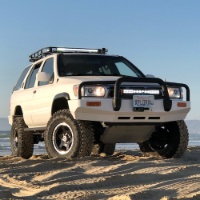
XPLORx4
-
Posts
2,583 -
Joined
-
Last visited
-
Days Won
47
Content Type
Profiles
Forums
Calendar
Everything posted by XPLORx4
-
I've beat on my R50 off-road pretty hard, and the rack and pinion has held up so far! I have about 159,000 miles on mine, with many miles off-road. Surprisingly, I've never bent a tie rod, and the rack itself is still in great shape. I think my P/S pump is starting to die, though. The rubber bushings holding the rack to the crossmember eventually crack and wear out, especially the bushing directly under the oil filter, which breaks down faster due to frequent contact with motor oil when the filter is changed. But overall, I have not seen any bad seals on the rack itself. From time to time, you will need to replace the inner tie rod sockets.
-
Changing the front coils may affect camber. On my lifted rig, for whatever reason, the camber is still in spec. Others have had different experiences, sometimes using one pair or two pairs of Ingalls camber adjustment bolts.
-
I guess I don't see how that's any different than getting taller or stiffer springs... except it's more ghetto.
-
2001 QX4 Headlights fitting a 1998 Pathfinder SE
XPLORx4 replied to CODY's topic in 96-2004 R50 Pathfinders
That's cool that you're doing so much custom work on the suspension. I don't think anyone has made a custom 4-link rear setup yet for the R50. Post some pics when you've made more progress! I'm sure we'd all like to see what you're doing. PS. Please disable your CAPS LOCK when you post; ALL CAPS text is harder to read. Plus, you may not be aware of this, but in the internet world, ALL CAPS is considered to be the same as shouting. -
Due to the front suspension design, the R50 is not easy to lift more than about 2" without fabricating custom drop-brackets at a substantial cost. So, the simplest way to get more ground clearance (and to fit larger tires) is to replace all 4 coil springs with stiffer ones. Though some people have also added 1" to 2" spacers between the top of the strut and where the strut mounts to the chassis, my personal opinion is that this is a bad idea. This is because there is increased risk of exceeding the CV joints' maximum operating angles and destroying them when a front wheel is in the air and turned fully left or right. Longer travel struts (which are not available anyway) would also result in the same problem. The main disadvantage of using only a 2" coil spring lift on the front struts is a phenomenon many refer to as "topping out". Topping out is the opposite of bottoming out, which is when the suspension fully compresses, such as during a hard landing after being airborne. Topping out occurs when the strut fully extends. The normal range of motion for the strut with stock suspension is somewhere around 4" up and 4" down. With stiffer 2" lift springs, the strut has 2" less extension, but now 6" compression. So, if you hit bumps, potholes, or uneven terrain that causes the suspension to extend beyond 2", then the strut will make a loud thunking sound as it reaches full extension and hits the internal bumpstop. Topping out is usually much more frequent just after the springs are installed. After a few months when the springs have "broken in" a little and settle, this won't happen as frequently. You generally don't need to replace the struts when installing 2" lift coil springs, but this is usually a good idea if the struts have many miles on them, due to the fact that labor to replace the springs is nearly the same as to replace the springs AND struts. However, if the struts are new or are in still in relatively good shape, you can reuse them.
-
1996 and 2000 model parts interchangability
XPLORx4 replied to rick88ss's topic in 96-2004 R50 Pathfinders
It wasn't really that much work. I visited a wrecking yard, where they had a tire-carrier-equipped Pathy, and I popped the plastic rear panel off the passenger side and felt around inside the cavity where the mount attaches. Took me all of about 10 minutes. In comparison, my rear bumper and carrier took a couple of months to build. -
2001 QX4 Headlights fitting a 1998 Pathfinder SE
XPLORx4 replied to CODY's topic in 96-2004 R50 Pathfinders
OH! Good point! You might want to get his front diff too, just in case his ratio is different from yours. -
2001 QX4 Headlights fitting a 1998 Pathfinder SE
XPLORx4 replied to CODY's topic in 96-2004 R50 Pathfinders
The front grille, fenders, and hood are different between the QX4 and the 96-99 R50 body style, so fitting the QX4 headlights won't be a direct bolt-in. With regard to the rear axle, it may be better for you to just swap third members (i.e. just the diff case), rather than the whole axle, since the shock mounts were changed in 2000. -
1996 and 2000 model parts interchangability
XPLORx4 replied to rick88ss's topic in 96-2004 R50 Pathfinders
That is correct. A few years ago I investigated this myself. I found that the right rear quarterpanels on tire-carrier-equipped Pathfinders have extra body reinforcements where the carrier mounts that other models don't. There's also some different parts on the rear bumper, where the carrier latches. -
Knock sensor doesn't need to be replaced. Speed sensor does, if that is indeed the cause of the faulty speedometer. A code reader should be able to ascertain whether there's a speed sensor error. FYI, my '97 has had the KS error code for over 100K miles. Meh.
-
Maybe they're 235/85R16's? They might rub, especially if the wheel doesn't have the proper offset.
-
The reason why your bumper popped out of the plastic bracket is because your tire contacted the mud flap. Even if you had a lift, the same thing would happen, because your tire is stuffed in the wheel well. Instead of removing the entire rear bumper as advised above, simply remove the mud flaps.
-
Off Road Safety and Passengers?
XPLORx4 replied to OfftourRoadie96's topic in 96-2004 R50 Pathfinders
I've gone off-roading lots of times with passengers. They're buckled in just the same as any other ride. If a child is a passenger, follow the child seat laws just as you normally would. The only real difference between off-roading and highway driving (besides the bouncy uneven ride) is that your and your passengers' safety is entirely in YOUR control, whereas on the highway you never know when the drivers around you are going to do something to jeopardize your safety. If you intend to drive rally-style or Baja1000 style, then perhaps you should consider a roll cage, 5-point harnesses, and a helmet for everyone. Just FYI, every year, the off-road club I'm in volunteers to transport disabled children to a wilderness adventure camp, accessible only by 4WD. It's a total blast, and no extra safety precautions are needed, even for handicapped children. Of course, the trail isn't insanely difficult, and with prudent driving is absolutely safe. There have never been any transportation safety issues. Here's an article about the trip (click here) and this video highlights the purpose of the camp. -
HELP! how important is it to have the rear bumpstops?
XPLORx4 replied to FUELER's topic in 96-2004 R50 Pathfinders
It looks like there's a few threads sticking out. If it were me, I would try to use a dremel or grinder to grind a slot in the top of what's left of the bolt, and then use a flathead screwdriver to remove it (along with using lubricants and heat). But the other methods suggested might work just as well. -
Umm....What is this supposed to be connect to?
XPLORx4 replied to EmptyV's topic in 96-2004 R50 Pathfinders
I've never seen such a connector. If you have a voltmeter, connect the test leads to the socket and find out if any switches (headlights, parking lights, turn signals, etc.) give it power. -
The problem could be caused by any number of things, including but not limited to worn steering components, alignment problems, worn suspension components, sticky brakes, or bad tires. This topic should probably be moved to the appropriate forum so other WD21 owners who have the 4" Trailmaster lift can help more readily.
-
A 5K or 6K winch won't be strong enough to reliably pull your rig if it's stuck. The rule of thumb is to get a winch that is rated for 1.5x your vehicle fully loaded weight. That means, curb weight plus you, your kids, your dog, your camping gear, your cooler, and full tank of gas. Just for reference, my rig (empty) weighs about 4700 lbs. I had it weighed at a truck scale. You need a winch that's strong enough to pull the vehicle weight PLUS overcome the friction or drag of the substance you're stuck in. It would be pretty lame to be equipped with a 6K winch that fails on you when you most need it. Also, if you plan to mount a rear winch closer further forward (closer to the axle) where do you keep your spare tire? Do you have a tire carrier?
-
My take on winch locations: Rear-mounted winch: Dammit, I got my wheels stuck in mud. Good thing I got that rear-mounted winch, I got myself unstuck, backed out of the trail, turned around and went home and spent the rest of the weekend wondering where the rest of trail leads... Front-mounted winch: Dammit, I got my front stuck in mud. Good thing I got that front-mounted winch, because even though I got myself all friggin' muddy reaching for the winch cable, I pulled myself through the mud, continued on the rest of the trail, and had a great time. However, a positive point about a rear-mounted winch is that if you attach it to a receiver, you don't have to have it installed all the time.
-
air lift 1000 air bags and other ?'s
XPLORx4 replied to mikeysentra's topic in 96-2004 R50 Pathfinders
Before I lifted my Pathfinder, I installed the Airlift springs you got for the purpose of supporting the rear end when I towed my boat. They worked really well. I even got the in-cab air compressor to inflate them on the fly, although you can inflate them easily with the included Schraeder valve (standard tire inflation valve). I installed the valve in the left rear wheel well on the panhard rod mount's angled brace, which is very easy to reach. As part of this suspension upgrade, I recommend you also pick up a pair of adjustable rear shocks, such as Rancho RS9000XL adjustable shocks, part number 99116. By setting them firmer, you can reduce rear end bouncing while towing. And when not towing, you can put them back to that nice plush ride you're familiar with. Finally, when you install the bags, do two things. First, use the CORRECTLY SIZED drill bit (I think it's 3/4") to widen the hole on the bottom spring perch, so that the air lines to each bag do not get crimped. Crimped air lines will eventually fail to hold air. Second, you will replace the factory bump stops with your new air bags. There's not enough room in the factory spring to have both the bump stop and the airbag there simultaneously. Do not discard the bump stops (if they are still in good shape) because if you decide to remove the airbags later, you'll need those bumpstops back. -
That's pretty normal, since your headlights are higher off the ground. Besides, when you're sitting in the driver's seat you can't even see the first 5-10 feet of [unlit] ground in front of the bumper anyway.
-
Looks nice! Congrats. Have you checked that the CV axle rotates freely and doesn't bind when the front suspension is fully extended and the steering is fully turned left and right?
-
HELP: front suspension noise after installing new cv boot?
XPLORx4 replied to fukkeneh240's topic in 96-2004 R50 Pathfinders
To isolate whether the issue is really the CV axle, I would really strongly recommend that you remove both front drive flanges so that the front drivetrain doesn't spin when you drive. Otherwise you're just wasting your time. If the sounds completely go away, then you know it's the CV axle, and definitely not related to the wheels, brakes, bearings, etc. If the sounds continue even with the drive flanges removed, then it's NOT the CV axles, and you need to focus your attention on other moving parts. -
Top one's the best. Looks good. I can't wait to find out how it works for you.
-
That's an interesting perspective. I've always observed that 91 is about 20 cents more than 87 (up to 24 cents more when gas is $4+), no matter how much regular costs, so when gas prices are lower, premium is actually much more expensive. At $2.09 [87] and $2.29 [91], premium costs 9.5% more than regular. That's a pretty substantial increase in relative cost per tank. If regular is $4.09, and premium is $4.34, using premium costs only 5.8% more. So, relatively speaking, it's not as big a difference to use premium when gas prices are higher. It seems to me that the actual dollar difference is the nearly the same between 87 and 91, no matter how much regular costs. Besides, using 91 octane in engines designed to use 87 doesn't serve any purpose except to lighten your wallet faster, unless your engine is prone to knocking. Higher octane gas reduces the frequency of knocking. Using 87 octane in an engine designed for 91 can result in lower performance and fuel economy. The VG33 engine in my Pathy has been on a steady diet of 87 octane for as long as I've owned it. There were only 2 occasions when I used 91 octane, and both times I topped off a partially full tank in order to get rid of pinging.
-
HELP: front suspension noise after installing new cv boot?
XPLORx4 replied to fukkeneh240's topic in 96-2004 R50 Pathfinders
As you said, you didn't touch the hub or bearings. The noise is likely your CV axle, but the best thing to do to confirm this, as I said before, is to remove both drive flanges, take a short drive around the block, and see if the problem goes away. If it does, then it's definitely the CV. If not, well then good thing you haven't spent an unnecessary $100, and more troubleshooting will be needed. And in case you haven't checked yet, look for a rock, nail, etc. that might be stuck in the tire tread, causing the tick tick tick sound.