- Sign In Changes: You now need to sign in using the email address associated with your account, combined with your current password. Using your display name and password is no longer supported.
- If you are currently trying to register, are not receiving the validation email, and are using an Outlook, Hotmail or Yahoo domain email address, please change your email address to something other than those (or temporary email providers). These domains are known to have problems delivering emails from the community.
Leaderboard
Popular Content
Showing content with the highest reputation on 01/29/2019 in Posts
-
Update: I replaced all 68 LEDs 5mm Clear Red High Bright 2.1v/30mA was the final measurements At about 13.2v Source. Took about 2hrs. Passed the inspection. Thanks yall4 points
-
Finally had one of my led brake lights die (lasted 11 years!), an own dome light & a few bulbs in the HMS light. Replaced dome, cargo, map, STT, HMS, & reverse lights with a combo of JDM & LUYED(sp?) led's. Interior is very well lit now and all the others seem to be of good quality and are substantially brighter than their predecessors. As a note, the led STT bulbs I had for 11 years were from superbrightleds.com. I did consider buying from them again, but their pricing on the newest/brightest versions are substantially more than other highly rated units. Figured I'd take a gamble on the cheaper ones, so hopefully they last a while.3 points
-
Wondered what the hell that noise was. It sounded like a wiper motor or a fuel pump having a really bad day, but it didn't stop when I turned the truck off. Then I got out and realized the sound was actually coming from the from four or five lonely bloodhounds in the back of a Chevy pickup parked nearby.2 points
-
The suggestion of bad hubs isn't entirely off base from what I've read (pistons get pushed back by the rotor wobbling, so you end up with free play in the pedal extending the pistons back out until the pads meet the rotors) but you'd only have the problem while the car was moving, and then it would pump back up after a few strokes. The Pathy brake booster I had apart did not have a solid rod from input to output, but the two rods met in the middle and should give a solid pedal whether the diaphragm is working or not. The slop between the two rods is what opens and closes the valve that controls air pressure against the back of the diaphragm in the booster. But no, unless the booster went entirely to pieces inside, a failed booster should not allow the pedal to go to the floor. (I replaced mine thinking it was the only thing left that could be wrong, and it solved nothing.) I'd be hesitant to say the new MC didn't do it without bleeding the thing first, even though it sounds like you were careful with it. I'd also be suspicious of the ABS system. After the fun I had last summer with mine, I hate brakes. There's no telling what's wrong unless it's leaking, or where the air is, or if there's air, or whether the new part or the bleed was what changed something.1 point
-
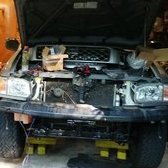
Maybe I’m just not seeing your vision, but I don’t see how you can get the rear ride height even remotely close to the front without biting the bullet and doing the necessary fabrication to drop everything down. Just by eyeballing it, it looks like you’ve got in the neighborhood of 20 inches or so of lift in the front compared to stock? Trying to get the rear down to that level without fabrication just doesn’t seem feasible to me. And If you want it to ride and track safely I really think you’re going to need to move the mounting points for all the rear links down to keep them reasonably in line with the rear axle. If you drop the axle that far and keep the existing mounting points for the rear trailing arms, you’re going to have them at some very extreme angles that could compromise performance and safety. Same thing for the rear driveshaft. I don’t know if will even extend that far stock, but if it does it will be at an extreme angle. I’m not trying to discourage you in any way. I think this project is awesome and really want to see a well put together SAS R50 hit the trails! I just think it is worth taking the extra time and really thinking this out and doing it right now that you’ve gotten this far.1 point
-
There is a big mountain range going though this state that I live on called the sierras lol. It can get fairly cold here, not as cold as some places but cold none the less lol1 point
-
Replaced the battery. The single digit weather in the northeast finally did it in and starting was a no-go. When I pulled the old battery out, I saw the date code on it.... C9. Damned near lasted 10 years!1 point
-
There is a droning/whining noise somewhere in the drivetrain of my 2000 R50 4x4. I checked the rear diff for fluid and all is well. The rear tires show no different wear from other tires. I will check “U” joints tomorrow. Will also check rear axle bearings by jacking rear end and placing on jack stands. Droning/whining noise diminishes with higher speed. But, am concerned. What think you all? Thanks for the input. MTG0 points
-
My 79 year old mother's Cadillac SRX (part of my inheritance..eventually) suddenly lost brakes. She came out of a store and when she hit the pedal, it went to the floor. Brakes had been working fine up until then. About a year and a half ago, all the hard lines had been replaced due to corrosion and her pads were replaced about 6 months ago. Anyway, she was able to limp it to her house. I stopped over to take a look and found the following: Running or not, the brake pedal goes to the floor when pressed. The brake fluid reservoir is full. There are no observed leaks around the master cylinder or junction block for the rear lines. After pressing the brakes a dozen or so times to the floor, there was no brake fluid leaked onto the driveway or any leakage around the calipers. So immediately I thought... master cylinder failed and ordered a replacement. Removed the hard lines (2) from the master cylinder and capped/plugged them. Swapped the reservoir to the new master cylinder and filled it with fluid. plugged the ports on the MC and held it in a bench vice. Using an old push-rod from a blown dodge engine, I forced the piston in the MC until it was no longer burping air and the piston was unable to be depressed. I felt that was a successful bench-bleed so I installed it in the vehicle, including using a syringe to add fluid to the rigid lines before installing in the MC (barely took any so I'm thinking that no air should have gotten into the system other than maybe a tiny bubble. I was very careful not to introduce air since it was cold and pouring down rain and I didn't feel like crawling under and bleeding the system. Got everything tight and wiped down... got in the vehicle and tested the brakes..... right to the floor DAMNIT! so, now I'm at a loss as to what the problem could be. What could cause a sudden loss of brakes that did not involve a ruptured line or failed MC? My understanding of the vacuum assist is that there is a hard linkage there through the diaphragm so even if the VA failed, brakes would still work. Any thoughts on where to look next? oh yea, and some clown on the Cadillac forums tried to tell me that a loose hub or wheel axle would cause that since the piston on the caliper would have to push much further if it were loose. He obviously doesn't understand disc brakes.0 points