- Sign In Changes: You now need to sign in using the email address associated with your account, combined with your current password. Using your display name and password is no longer supported.
- If you are currently trying to register, are not receiving the validation email, and are using an Outlook, Hotmail or Yahoo domain email address, please change your email address to something other than those (or temporary email providers). These domains are known to have problems delivering emails from the community.
Leaderboard

(1)_opt.thumb.jpg.035a5eb628baefe0934fbb6e70f9b39e.jpg)
Popular Content
Showing content with the highest reputation on 01/11/2019 in Posts
-
It's doable, but 2" W material would be better. For reference, this is what my current spacers look like: It's constructed of a piece of 2.5" sq. tube x 2.5" H x .250" wall, with 5.5" L x 2.5" W x .25" pads to make a 3" spacer (the height is irrelevant for this discussion, though; the 2.5" W base is what matters here). You could easily just use a 2.5" x 2.5" x 5.5" tube to replicate this like other spacers, normally 2" W x 4" H x 6" L for some of the traditional spacers. I did 5.5" L spacers to avoid having to notch anything for the passenger side where the brake lines come down (the metal guard shown in the pic). Here are the gotchas: 1. A 2.5" wide spacer is just a tad too wide. On the rear subframe, the width is perfect relative to the chassis. But, the unseen lower edge of the spacer actually sits atop a weld on the subframe, like so: For the rear spacers, you could obviously offset the holes on the spacer to get around that, but the spacer wouldn't sit flush. Also, if you do a simple tube approach, you have the radius edges to your advantage to some degree, but it may still be wide. 2. The front spacer is a little similar, but you can't offset the holes because of the lip on the chassis: Although this fits flat, it does barely contact similar weld on the subframe, it doesn't give much wiggle room for installation. The radius edge of the tube would help here. 3. A 2.5" sq. tube, presumably .250" if hitch steel, only leaves 2" of tool space inside the tube for tightening hardware. It's doable, but just be prepared to make a lot of small motions to get the upper hardware tightened. And if you orient the lower bolts tip-down (which you should), be sure to put those bolts in sometime before sandwiching things together, otherwise you might not have the clearance to insert the bolt or upper nut. That all said, eventually I will go to spacers with a 2"W base to get around those issues, or possibly convert these by welding on a 2"W x .25"H plate to the bottom of each spacer to clear the subframe welds (resulting in a 3.25" spacer).2 points
-
All great points! Yes, those numbers are bench-test specs, and the value can increase under load due to the spider gear push-out. Yeah, I don't get why the numbers were so diluted for the 03-04. Stability controls would be a good guess, but I'm not even sure many of the vehicle had anything beyond ABS. Of the R50s I've seen with VDC (literally one), it didn't even have the LSD. I think Nissan just got a good deal on those spacers in the units, which consumed the space of 4 pieces in the clutch pack, and still allowed them to market the option. Good point about the fluid. Yes, an additive or LSD-safe gear oil is required. Just realizing I omitted specs from the 99-00.5 Frontier for some reason. MY99-00.0 trucks were 144-178 ft-lbs, then 00.5 went to 138-180 ft-lbs. But yes, both 00.5-02 Frontier and 00-02 Xterra LSD diffs make great swap options because they had the better numbers and because they used the same gear ratios, specifically 4.363 (48:11) and 4.636 (51:11) options, not the 4.375 (35:8) and 4.625 (67:8) options found on older Nissans. You can swap the entire 3rd member; completely bolt on. I've actually been sitting on my re-packed LSD for a while now, and re-acquired the other re-packed unit just the other week. Both eventually replaced by lockers, but I really enjoyed having it. Lokka + LSD made for a great combo. I suppose it's time to find those units new homes...2 points
-
They will fit but again need to be mounted upside down. However, this is entirely doable. This is because firstly, unlike the KYB, the Bilstein is a monotube shock and will work inverted, instead of having no damping and eventually failing like the KYB will. Secondly, the Bilstein has no steel shaft cover, so will not fill with water/mud. I would still recommend using a rubber cover to avoid grit damaging the seals. Lastly, I actually recommend mounting them upside down on the pre-facelift anyway, as some longer shocks will hit the panhard rod and become damaged if installed with the body down. The altered mounts on the facelift solve this problem by moving the bottom of the shock further out.1 point
-
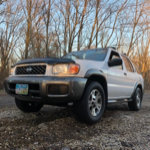
Took some pics the other day. Trying to keep her somewhat stock, but the temptation is unbearable! Sent from my iPhone using Tapatalk1 point
-
What size tires are you running? The LE came with 4.363 gears from the factory. You can confirm this if you look on the VIN placard on the firewall near the windshield wiper motor. You'll see HG43 (or HG46 for 4.636 gears). If you're running up to 31" tires, you can regear to 4.636. Regear to 4.875 for 32" tires. Regearing to 5.13 is better suited to 35" tires or larger. Install a speedometer recalibrator (http://yellr.com) after re-gearing to restore speedometer accuracy.1 point
-
A little more lift over SFD height is fine, and in fact what I recommend. It's a trade-off for ground clearance over OE geometry. As for bumpers, I'd like to. It's a long term plan @TowndawgR50 and I have discussed. This may delay getting some of the bumper brackets out from my other thread; seems more convenient to have built, DIY, and builder parts options. The near term focus is SFDs, though.1 point
-
I've done a 2.5" SFD, with 1.5" strut spacers and OME MD springs and a set of camber bolts. Shouldn't have any issues with your setup. The 2" strut spacers give a little north of 2" lift because of the geometry of the suspension. Not sure it's 2.5", though, but perhaps somewhere in between. As long as you can weld, you can make the Accord link work. Just keep in mind that's a very custom approach. I'd still pony up for a Woodward link. If you ever increase to a larger SFD, you can just re-use the joints and swap in a longer shaft. Notably, if you're not in any rush to do the SFD, perhaps hold out a little longer? An SFD kit is in the works.1 point
-
got the rollers on today. Used the 5 to 6 lug adapters to get the r50 pattern to work. Figured if i'm going to use spacers they will be done right. Loktite and torque wrench. Upper links all set up, and then got rid of the jacks! Finally on its own weight! Tomorrow i'll finish the bottom links and the trackbar bracket hopefully. Drilling the knuckle and pitman arm to run heim steering also. Those are 235/65/15 incase you are wondering.1 point
-
I'm curious about the noise. The LSD doesn't quite "engage" per se...whether straight-ahead or turning, the clutch pack is always under compression, but there is a change from no-friction to friction when making turns. Because there are also spider gears in the diff, any engagement sounds are might be attributed to those, and not so much the clutch pack (i.e., the "limited slip" part of LSD). I assembled this chart from FSM data when I repacked some LSDs a while ago: Pretty clear the R50 never got what other trucks got, and then Nissan dumbed everything down 03-04. Re-packing does require some work...and homework. Not so much adding shims but just increasing the friction for the clutch packs. This can be done by thickening the stack (replacing thinner pieces with thicker ones, or shims), by replacing pieces of one type with another, particularly in the case where similar parts are next to each other. For example, on 01-02 R50, a 2:9 ratio means that, those 2 friction discs are only in contact with 3 friction plates, at max, and the rest are just used for spacing (FP-FD-FP-FD-FP-FP-FP-FP-FP-FP-FP); all of the breakaway torque comes from the friction on those 10 pieces (5 per side). The 5:6 models had more than double the friction area, and consequently higher breakaway torques. However, you'd expect the 6:6 to have higher numbers, too, but the breakaway torque is also controlled by the nominal thickness of the pieces, plus any compression added by spring plates. That is to say the R50 LSDs used more thinner pieces, which would reduce stack compression and ultimately friction. In your real-world scenario, if you have an LSD and the tire is still spinning, that means the ground resistance on the tire that has traction is higher than the breakaway torque of the LSD. In that case, it behaves like an open diff because it's defeating the clutch pack and the spider gears (the "differential" of LSD) are allowing the excess torque to rotate the wheel with less traction.1 point
-
It is a 97 se. And has a LSD in the rear.. with a manual tranny and manual hubs up front. I didn’t check the other side. LSD has been making some odd engagement sounds when going from stop to hard turns.. I have been stuck on a snow bank before with only the front left and back right spinning.. Thanks everyone y’all rock!!1 point
-
+1 to what the others have said. Sounds like the rear wheel on the other side was spinning. When you're in 4x, the front and rear driveshafts spin at the same rate. There's no differential in the transfer case to bias torque front or rear, so the front and rear diffs turn at the exact same rate. Each diff applies the same torque to both wheels on its axle--but if one wheel doesn't have enough traction, it spins and the other doesn't (the torque it takes to spin the wheel without traction is not enough to spin the wheel that does have traction and is trying to move the truck). If the truck is on uneven ground, it'll have less force on two wheels diagonal from each other (think of a four-legged bar stool on an uneven floor). If the suspension can't keep the wheels in good contact with the ground, those two unloaded wheels spin while the truck goes nowhere. Look where your tires are in your wheel wells, your driver's front is drooped way down (unloaded) and your driver's rear is stuffed into the wheel well. The passenger's front and driver's rear were supporting most of the truck's weight, so the other two had bugger-all traction and the truck wouldn't climb. If you don't have one already, you might try and track down a limited slip rear end (identified by an orange sticker next to the fill port that says LSD OIL ONLY). I like the limited slip in my '93, though it does have its limitations. IIRC the R50 LSD was toned down a little (probably because LSD makes it easier to make the rear end step out if you drive like a maniac. The LSD can be repacked to tighten it up. It's not as good as a locker but it's much better than an open diff IMO.1 point
-
There's actually 2 relays in the in-line fusebox. I only took a picture of one as they're identical.1 point
-
Yeah, it did originally have the de-icer but it doesn't work now as the truck has had several new windscreens. I don't need it anyway as NZ doesn't get cold enough, although there was that one time the wipers iced to the screen at the skfield... Would have cost me $$$ anyway. I think my truck was factory fitted with a cold weather pack - it's got the de-icer, twin batteries and the rear LSD.1 point
-
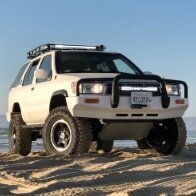
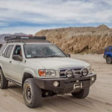
Little group trail run Sent from my SM-J727T using Tapatalk1 point
-
This is about the only time wifey rides in the Quey anymore1 point