- Sign In Changes: You now need to sign in using the email address associated with your account, combined with your current password. Using your display name and password is no longer supported.
- If you are currently trying to register, are not receiving the validation email, and are using an Outlook, Hotmail or Yahoo domain email address, please change your email address to something other than those (or temporary email providers). These domains are known to have problems delivering emails from the community.
Leaderboard




Popular Content
Showing content with the highest reputation on 05/14/2020 in Posts
-
My 1998 QX4 Sent from my iPhone using Tapatalk1 point
-
Yes if it is a body lift. May need to drop your radiator too, depending on engine and fan combination on your car.1 point
-
Sent from my iPhone using Tapatalk
 1 point
 -
K, so I put a vg33e in my 1993 4x4 auto recently and I've been fine tuning it for about a couple of weeks. A while back I snapped off my last ignition key in the passenger door lock. I managed to get the busted off keyed portion out of the lock cylinder and stuck it in the ignition cylinder, then used a flathead to start it and turn it off. The ignition cylinder started to stick, so when I turned it to the starter trigger mode it wouldn't spring back to run and it kept the starter engaged until I manually turned it back to the run setting. This put a lot of wear on the starter, and I became very worried about the flywheel. I finally put in a new ignition cylinder, but not an oem one that goes on the steering column, but a generic one for lawnmowers and four wheelers, i guess. It took me a while to get the wires right, but I drove the truck around for a week with this setup and it seemed to work fine, except i couldn't get the tranny control module to perform the diagnostic process and that's currently irrelevant. I was driving it yesterday and it started making this loud squeal or screech. I pulled into a gas station and shut it off, then tried to start it again. It made squealed and I think it shuddered while the starter was engaged... It didn't really sound like a belt squeal so I consulted my dad and we decided it was probably the starter gear not retracting and interfering with the flywheel, producing the clacking and the squealing. I went and bought a duralast gold starter, all new components, and put it in. This was a massive pain with the header on, and the new starter had a bracket for the trigger plug that was in the way, but I'm not here to complain about that. It started right up and sounded fine at first, but when I backed up the slight hill and put it in drive it started clacking and squealing again, just like before. Unfortunately I don't remember if it started when I put it in gear, when I gave it some gas, or at another point. It also seemed to have a distinct lack of power, but it had a power loss problem before this which I've been trying to fix. I think it still has exhaust leaks in the new system i installed. The rattling could be caused by the fact that the passenger side header isn't in the Y-pipe flange at all, but held in place by a plumbing band clamp (i know, I know, I'm getting there...). It had a subdued clack before which I attributed to the loose exhaust connection, but it's worse now. Additional information: *once it started making the noise it continued in neutral and park, only stopping when i killed the motor *the ac was off and i wasn't steering the whole time, so i doubt it's the ac or power steering pump belts or pulleys So I need to get some opinions. Do you guys (and/or girls, I'm not picky about advice) think my torque converter is loose from the flywheel? Or the flywheel is loose from the engine? I didn't change the flywheel on the engine i swapped in, it's the original one from the 3.3. I'm almost completely certain that I indexed the torque converter to the transmission correctly, but it did take me a few tries, so maybe I damaged something then? Or is it probably just a squeaky alternator pulley/belt and the exhaust rattling? I didn't check any belts when I was there, i got freaked out and came home to check my favorite forum and have some chocolate coffee beans... I've been driving it for a few weeks since I first started the new 3.3 (not really new, but about 50,000 miles from a Japanese fleet Frontier) and it hasn't made any crazy squealing sound before. It's been shifting fine, though a bit late occasionally and some odd downshifting, but I figured that was because of the pinched vacuum lincoming off the air intake tube and the exhaust leaks. I was under the impression that if I hadn't properly indexed the torque converter and bolted it to the flex plate the tranny would have self destructed when i first started the swapped engine, or first put it in gear. I even pulled a 6000lb Plymouth Trailduster about three miles on hills two weeks ago and it pulled it like a champ. I've been testing it against more and more difficult tasks and it just kept running better and better, and then this happens. I would really appreciate it if anyone had any idea of what's going on with my truck.1 point
-
I’d pick OME over AC springs any day. Better ride, having used both MD and HD (current) options. They’re also cheaper than the AC springs, which have been reported and being too stiff and causing top-out. AC sells both (the ~$167 options are the OME), but in general you’d also be better off finding them elsewhere for the same price and free shipping.1 point
-
VG30 VG33 I see a slight difference in the placement of the bendix. The bellhousing on the RE4 fitted to a VG30 might be a little different than the bell housing fitted for the VG33. I assume the bellhousing differences between all the separate RE4 applications aren’t reflected anywhere in the part number. Just like you can get a “2WD” RE4 and the only difference is the extension housing, the RE4 fitted to your original VG30 might have a different bellhousing. Since it mated to the VG33 engine just fine and the torque converter bolts lined up, I’d say the only difference is the area where the starter mounts. I had to use multiple shims to get my starter back a solid half inch so it would stop contacting the flex plate and before the shims I couldn’t turn the engine over even with a huge breaker bar. I remember thinking that I could just leave it with 1 set of shims and maybe eventually it’ll eat away at the metal until it’s not touching anymore. Maybe something similar is going on with yours. Maybe the bendix was indeed staying engaged and it finally broke in some way that is now only catching the flexplate in a certain position. Or maybe the different starter mounting caused the starter to contact the flexplate, bending the flexplate, and now it is making contact on each revolution. Sent from my iPhone using Tapatalk1 point
-
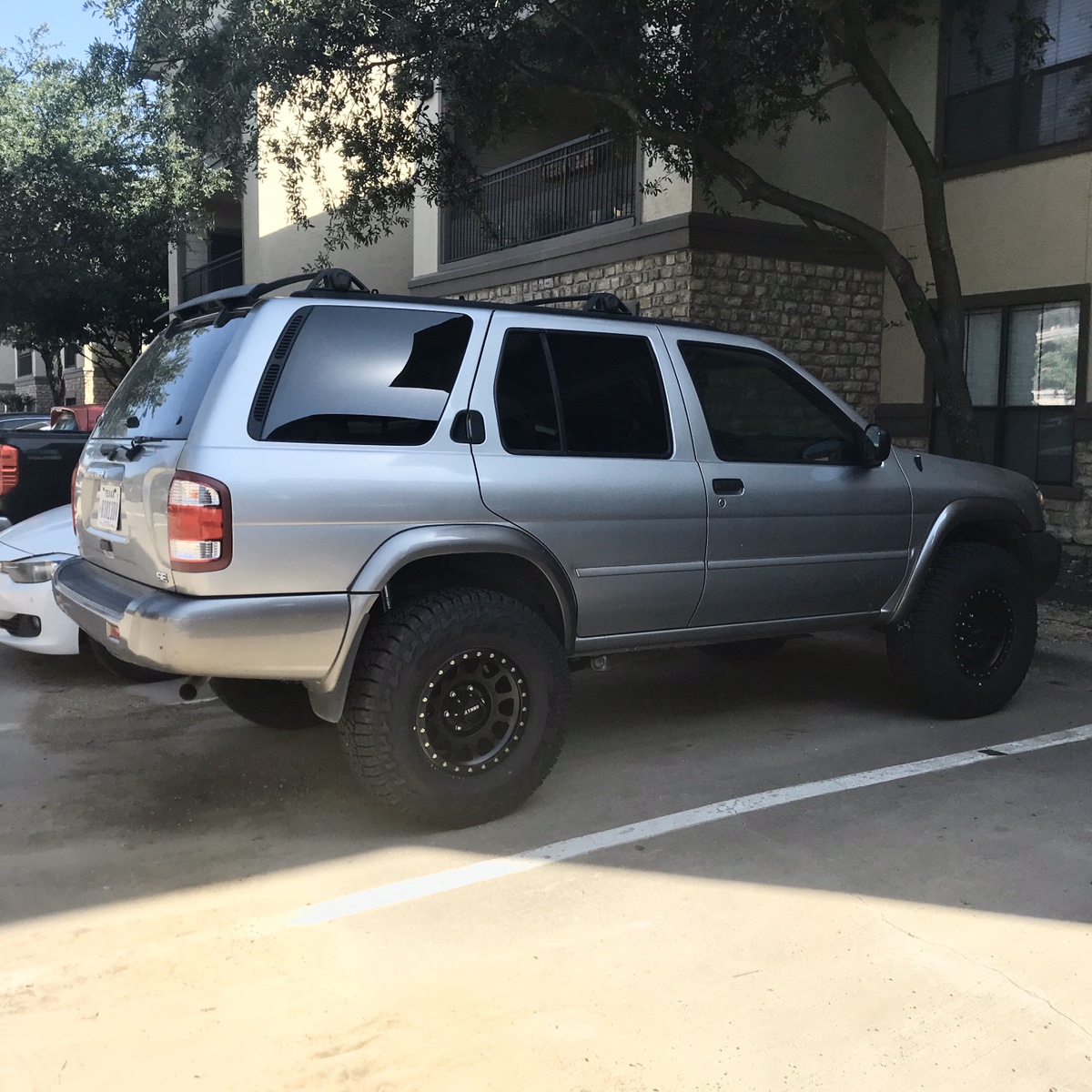
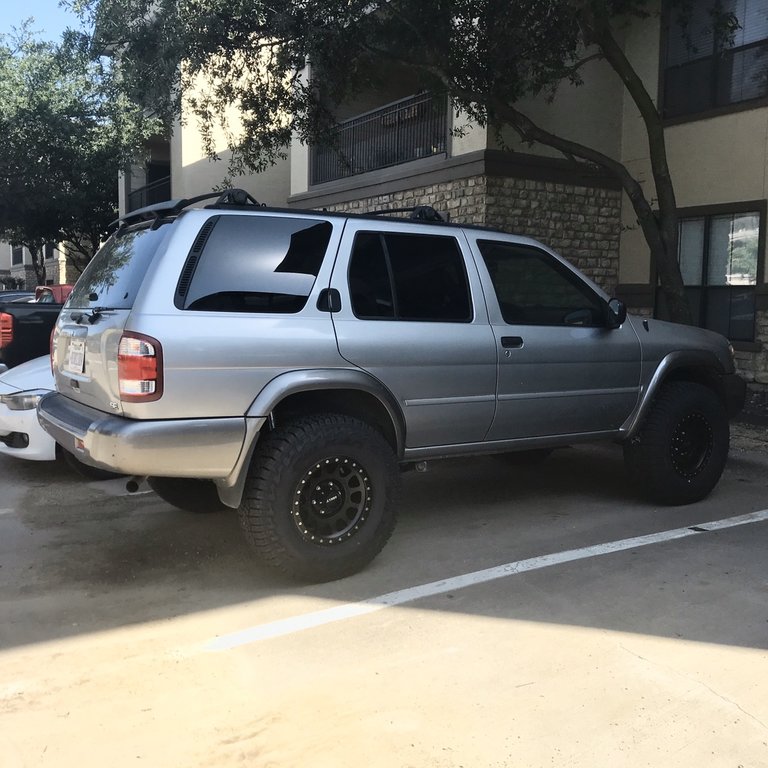
How many miles do your current struts have on them? The reason it's generally advised to change them at the same time is because, in order to install a coil lift, you have to totally disassemble the strut. While you're doing that much work, you may as well put new on generally. KYB struts with OEM Nissan bearings are a very popular and good option as far as that. Rear shocks only take 2 fasteners to change, so it's up to you when to change them, however longer rear shocks will allow you to take advantage of the additional suspension flex lift coils will make possible. In addition, using a nice shock like Bilstein will improve ride greatly. As far as spacer vs coil, it depends on your intended use of the vehicle, budget, and what you want as far as ride quality. There's a lot more to consider than it seems at the surface. For spacers they will all function the same, so I always recommend Steve's product (sfcreation.com) as he's a long-time member here on the forum and I personally enjoyed his products on my rig. For coils there's two primary options: Old Man Emu or AC. OME (Not to be confused with OEM!) is produced by ARB in Australia and give phenomenal rode quality on and off road, however at less of a lift; right around 1.5". AC will generally ride harsher and may cause your front struts to "top-out" potentially causing them to wear prematurely. However, they provide a true 2" of lift and can take heavier loads better. They're great for a rig laden down with skidplates, rock sliders, and bumpers, or just anybody who doesn't mind a little harder ride who also wants a good amount of lift. My personal recommendation based upon my own experience is a 1" spacer lift paired with OME springs, however this is making out what the R50 platform can take at 2.5" of lift and can make alignment a bit of a PITA. Here's a breakdown of some things to consider: Spacers: Good: -cheap -simple -you can add/remove to level out your ride, especially as you change out springs -maintais factory ride quality Bad: -changes the location of the range of motion of the CV's, which means that at full droop they could bind (I can explain this more if you're confused, I may even do a write up on it with diagrams since it tends to confuse newbies!) -maintain factory ride quality Springs: Good: -stiffer ride/better load carrying capacity -keeps CV's in stock range of motion (again, I can explain of you'd like) so no binding issues Bad: -in some (definitely not all, don't let it scare you!) cases may damage struts -stiffer ride -more expensive Hopefully that's helpful for you. I think it's fairly comprehensive, but it's late and I just got done with 4 days of working on my 4Runner, so I'm tired haha.1 point