- Sign In Changes: You now need to sign in using the email address associated with your account, combined with your current password. Using your display name and password is no longer supported.
- If you are currently trying to register, are not receiving the validation email, and are using an Outlook, Hotmail or Yahoo domain email address, please change your email address to something other than those (or temporary email providers). These domains are known to have problems delivering emails from the community.


PFFlier
-
Posts
49 -
Joined
-
Last visited
-
Days Won
1
Content Type
Profiles
Forums
Calendar
Everything posted by PFFlier
-
Yes, it was leaking, which is what started this whole project. You could see where dirt was stuck to the oil flung on the floor aboveand the exhaust as well as all over the front of the diff. I figured the groove was from the inside lip of the seal.
-
Well, I'm glad it's not not just me. I finally got through by clicking on advanced then at the bottom it gave me a choice to proceed anyway. Even though I have added the website to the "allow list" it still blocks it. Your comment gives me more patience to wait it out for an admin fix. Thanks.
-
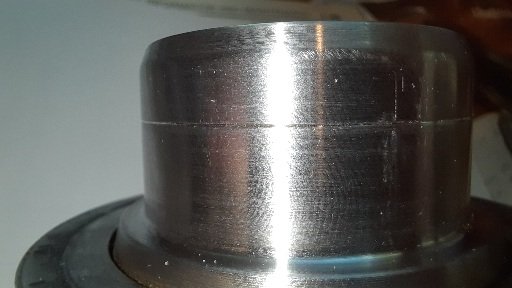
Can definitely catch a fingernail in the groove. It only measured .002" less in diameter which is .001" deep per side. Not sure if micrometer is getting to the bottom of the groove all the way. I hope the speedi sleeve works.
-
Has anyone had a hard time getting to this site because of "Not secure" warning? I'm using Chrome. It was fine until last night.
-
Here's the picture of the groove in the yoke:
-
When I went to clean up the yoke I noticed the surface where the oil seal rides had a groove cut in it. I worked on it with crocus cloth but couldn't get rid of it so I ordered speedi sleeve for it. Never used one before, looks like you can use the same sized oil seal. Shipping goes slow this time of year, especially with all the snow (here in northwest. So now I wait....
-
Thanks for the replies and clearing that up about mine having the H233B without crush washers. What a relief. I notice it doesn't say in the instruction but do you recommend using a little RTV on the inner 1/2" of the yoke splines to keep oil from seeping through? That's pretty common on other vehicles.
-
Well, I thought I had the procedure down. Saw a couple videos and also had done it on my F150 before so I went for it. Now I'm ready to put the new pinion seal in and put the pinion flange nut on and finally found out that I was supposed to measure the torque required to remove the nut, but I didn't. So I'm wondering if I can set the preload to 4 to 8 inch pounds (with tires and drums off) by applying whatever torque that requires and call it good. Any ideas? BTW this is a 1991 PF with LSD.
-
Trouble removing key from ignition in wrecking yard on 94 PF
PFFlier replied to PFFlier's topic in The Garage
Good to know........Now I have a better idea what I'm getting into next time I head to the wrecking yard. -
Trouble removing key from ignition in wrecking yard on 94 PF
PFFlier replied to PFFlier's topic in The Garage
The one it is going into is an AT also. -
Trouble removing key from ignition in wrecking yard on 94 PF
PFFlier replied to PFFlier's topic in The Garage
Thanks for all the replies. The key is not rusted in place. You can turn it like starting or off but just can't remove the key. It jiggles around slightly like a normal one. Sounds like the best idea is to remove the whole thing but I wanted to make sure the key worked on the doors before I bought it since the door lock cylinders are what I need most. Is there a trick to getting the lock cylinder out? -
I stopped by a wrecking yard the other day and found a PF with a key in the ignition. I need the key, cylinder and door cylinders. It is an AT and there is no engine or battery in it. They key will not come out. There is no release button. I'm thinking it must be a sensor wired to it that has to be in park. I tried putting it in park, but with no battery and probably no cable, it would not open. Does anyone know if the key cylinder needs voltage to it (like 12v) to allow the key to be removed? Is there a way to fool it?
-
OK. Here is the update on this saga. I took it to a mechanic to help pin point our diagnosis. He did the a compression test with plugs out, then put plug into adjacent cylinder of questionable #6 and the pressure went up 10 pounds so we figured the head gasket was going. Replaced head gasket, it ran great for a day or so then ran crappy again. Then it hydro locked when I was trying to start it and I knew it was probably a leaky injector. #2 had fuel in it. I took fuel rail off but left it hooked up to fuel lines, disconnected coil, then removed distributor, grounded its case, then slowly turned the distributor cam gear and observed injectors as their short little burst occurred in firing order. About the 4th time through the sequence #2 stuck on like it was peeing, even after forwarding to other cylinders, even after turning key off until all pressure was bled off of line. So I knew injector #2 needed replacing. When I removed the fuel rail to disassemble I noticed the vacuum tube to the fuel pressure regulator had fuel in it (it was dry earlier in this article) so I ordered one of those up at the tune of about $75.00. Now about 700 miles later it is still running like a top. Drove it around the Olympic Peninsula camping and it ran great. All's well that ends well! PS: that injector I replaced tested fine for resistance. Must have had a bad spring inside or something.
-
I have considered the fuel pressure regulator and plan on testing it and the fuel pump as soon as my fuel pressure test gauge kit arrives. All I know right now is the regulator doesn't seem to have a leaky diaphragm since there is no gas leaking out the vacuum connection when I pull it loose. I replaced the fuel filter before I resorted to removing the fuel rail, so no I didn't clean the lines before the filter, although I was able to blow through the old filter easily, indicating that it couldn't have been to bad. #6 is the new injector, so that isn't the issue either. As far as fuel line blockage, the fuel comes into injector 5, 3, 1, 2, 4 then 6. Since 1, 3 and 5 are clean and normal, 2 is black, 4 and 6 are better, but not as clean as bank 1, the statement about it being higher pressure before the blockage and lower ahead of it, doesn't make sense in my mind. I'm glad to know others are brainstorming this though!
-
I checked the compression and the cylinders were all about 175 except #2 (the bad one which was HIGHER!!! I did it 3 times on that cylinder and got readings of 185 210 and 200. Since that is the cylinder that was fouled the worst, it isn't because of low compression. I have one of those testers with the flexible hose about a foot long with the threaded brass end with a rubber o ring. They are difficult to make sure you are turning them to equal torque when it is down 10" inside the manifold collector, so that could account for some deviation. Still waiting for my fuel pressure gauge to arrive for more thorough testing of the fuel pump and fuel pressure regulator.
-
I got no moisture under the hood between when it ran good and when it didn't (or any other time recently). Also, as I mentioned, the plug and cable spark strong when I pull the plug out. Plus I swapped plugs just in case and no change. I think I will do a compression test just for the heck of it.
-
Where is that warning light and what does it look like?
-
OK, here is another thing I thought of.......the only think I did between when it ran good and the next day when it ran bad was I washed it. I also washed the door to the gas cap and inside the door area which was crudded up with grimy dirt from years of not being cleaned. I was using water and a brush then rinsing it with a regular spray (not pressure washing). The cap was tight so I figured this was safe. I don't think this could have done any thing to the cap or got water in the tank but I thought I'd throw it out there for feedback.
-
Slartibartfast mentioned a ground issue which brought to mind something I had meant to check.....those two ground wires on the front top of the engine connecting to the manifold collector, so I cleaned them up and reinstalled but it made no difference. I also took a closer look at the plugs in 2, 4 and 6. 2 is the worst and is all black with gas on it. 4 was better but not good and 6 was even better. I did a drop test unplugging the plug wires one at a time with the engine running. 2 made no change, 4 made a slight change and 6 made about a normal change like 1, 3 and 5. So I plugged a spark plug test light to plug wire 2, then 1 and they both lit up the same. Next I tried pulling plug 2 (the blackest one that made no change when unplugging during running) and plugged it into the plug wire and laid it on top of the engine, started it up and it had a nice bright bluish spark. Remember, this thing ran like a top for a day and a half after I put it back together before it suddenly the next day wouldn't run right. It puts out a lot of grayish smoke. I don't even want to drive it cause I don't want to mess up the O2 sensor or the cat any more. I did order a fuel pressure gauge kit that should me here in a few days. It is such a pain to take the fuel rail out that I think I will wait until I get the tester and eliminate the low fuel pressure possibility. As far as the suggestion of the T-belt sipping, it seams like all the plugs would miss equally and the drop test would have had different results. That's just my reasoning, I'm not saying that I'm right!
-
Pulled the plugs again to see what they look like. 1, 3, and 5 look fine, maybe a bit lean. 2, 4, and 6 are fouled with only about 30 or 40 miles on them. The previous plugs looked good before I changed them. Anyone know why bank 2 would misfire? It only has a single coil and control module as far as I can tell.
-
One day a month or two ago my 91 Pathfinder (VG30E with only about 85K miles) started up rough and when running it in neutral or under load it seemed to miss worst between 1200 and 1500 RPM's. So about 3 weeks ago I finally had time to work on it so I started with the usual suspects, replacing the plugs, cap, rotor, PCV valve and when that didn't do it, the fuel filter and ran some seafoam through the intake and the gas tank. Still running the same, I took it to my son in laws who has a 92 like mine and we started swapping out things trying to isolate the problem, the plug wires, coil, MAF, TPS. Still running the same. By the way, his ran great. This led me to suspect plugged or bad injectors so I listened to the ones I could get to, 1, 3, 5, and 2 and they sounded fine. After talking to a mechanic he thought I was on the right track so I removed the injectors and took them to him. There was quite a bit of crud that came out of the fuel rail when I removed the first injector which happened to be #4. He didn't have an adaptor for that style injector to do a flow test but he put power to them and they all started clicking, checked them with an ohm meter and all read about 11.6 ohms except one which read 126 ohms so I replaced it and had him clean the rest. I bought new o rings and put the injectors back in, replace a couple. Funny thing was, when I checked them at home the bad one read about 16 ohms vs 11.6 or so. Maybe something is loose inside and moving around changing the impedance. Anyway I replaced it. I also had found a wire going to the #4 injector that had the insulation chewed off of part of the wire but there were no shorts. I bought some liquid electrical tape and put a couple coats on it before assembly. After putting it all back together I started it up and it ran perfect. Took it for a test drive a couple miles and it was fine. The next day I took it about 20 miles with mixed driving and it seemed cured (although it did seem to have to crank longer that usual before starting. Then yesterday I started it after about 5 seconds of cranking and ran like crap. It seems to idle fine at about 750 or 800 and pretty smooth but as soon as I bring the R's up it misses badly. Drives worse than before. Runs bad hot and cold and in between. I'm wondering if the longer cranking is a result of a weak fuel pump??? By the way, before doing the injectors I ran the computer (mode 1, 2, 3 and 4) diagnostics and everything read normal. I couldn't find a Schrader valve to use for testing the fuel pressure. I could use some help figuring this one out. Any ideas on what could be the culprit? ECM?
-
I will be putting the old 4x4 oil pan on the JDM. The old pan had a full gasket but the JDM only had a gasket where the half round part is for the crank on the front and back. The old one with the gasket leaked, but it also had 240K on it. should I put a full gasket on the JDM when I put the old pan on it????
-
Well, I got my old VG30E engine out of the 92 Pathfinder and onto a stand and got my new JDM (Japanese Domestic Modle) on a stand and I'm swapping out parts. The one they sent me (Foreign Imports in Lynwood WA)is from a 2 wheel drive and mine is 4x4. I'm trying to figure out if there is anything I can leave on the JDM and not have to swap out. So far I'm planning on swapping the engine mounts, exhaust manifold, intake manifold, fuel rail, oil pan, oil pump, and oil pickup strainer. It looks like I will probably also have to swap the thiming belt covers, all pullies, water pump, distributor and all cables and harnesses. Since the old one might have gone out from poor oil circulation, I'm thinking I should get a new oil pump. I may have to swap the valve covers too since some of the outlets for EGR are a little different direction. The water pump housing looks very close......may be a couple degrees different in the angle that the hose comes out. Has anyone done one of these that knows about this process? The timing belt looks brand new, but I'll probably change it anyway since I have to take it off to swap the oil pump. I'll need a new driver side engine mount because the one I took out was completely broken in the rubber area. It looks like the flex plate is about the same so that should be OK. It's too bad I can't use more of these parts because they are like new and mine the old ones have 240K on them. The injectors and rail are different......too bad because the old connectors don't snap on very well. Any help or input is appreciated. Thanks
-
Is it actually possible to tighten the bolts if they are loose through the starter hole, or do you mean just to inspect? I'm assuming the inspection is all "feel" and not sight, right?
-
I'm trying to fix my son in law's 92 Pathfinder. This is the same one that I did the headgasket and timing belt a month or so ago. It started with some occational tapping which came and went. It later became a banging noise and we had to toe it home. It sounds like it is coming from the bell housing and could be a loose or cracked flex plate or loose bolts on the torque converter. It is hard to tell where the sound is really coming from for sure. When you run it (parked) and change thru the gears it seems to do it in all gears, but the sound isn't constant and its like the varying load causes someting to start flopping around in there. Sometimes when you start it up it sound almost fine. Give it a little gas then it gets banging/clattering even when you drop it to idle. Does anyone know if you can look through the starter hole to see if the flex plate or torque converter are loose? Or maybe feel throught the hole with your hand? I't like to get some verification of the problem before going through the hassle of dropping the tranny. Does anybody know if there is a well documented tranny removal with pics or video? I do have the factory manual PDF files already but the troubleshooting they give is more for things not working or slipping, not sounding like they are going to fall apart!